



Running a small or medium business is tough. You’re expected to deliver big-company results, but you don’t have a big-company budget. For years, those old-school phone systems, you know the ones running on copper wires and clunky PBX boxes, have been quietly draining your time and money. They’re fiddly, expensive to keep alive, and honestly? They just weren’t built for a world where people work from home or the local coffee shop. But here’s the good news: things are changing. And the single smartest move you can make for your business today is to switch to VoIP phones for business. This isn’t just about making calls. It’s a real upgrade that makes customers happier, cuts your bills, and gets your business ready for whatever comes next. SMEs using VoIP reduce communication costs by up to 60 percent while improving response time.
What Are VoIP Phones for Business?
VoIP (Voice over Internet Protocol) converts voice signals into digital data packets transmitted over your broadband connection. Unlike traditional analog phones tied to physical lines, voip phones for business look like standard desk phones but function more like smart devices. They integrate with CRM software, enable video calls, and offer click-to-dial features from your computer.
This shift from circuit-switched to packet-switched communication is the difference between a horse-drawn carriage and an electric vehicle. Both get you from point A to B, but only one opens a world of efficiency.
The Five Pillars of Transformation for SMEs
Look, when you finally ditch that old PBX dinosaur and switch to VoIP phones for business, stuff actually changes. Here’s what happens, department by department.
1. Slashing Telecommunications Costs by 50-70%
Let’s talk money first. Old phone systems bleed you dry.
- Per-minute charges? Gone. Long distance fees? Also gone.
- You pay one simple flat monthly fee per person. That’s it.
- No need to run two separate networks anymore. Your internet handles everything.
- Calls between your own offices? Free. Even to other countries.
- Remember those painful hardware upgrades every few years? Poof. Your provider handles all that now.
True story: One manufacturing SME saved a ton of money in a single year. They threw that cash straight into marketing and new products.
2. Enabling True Hybrid and Remote Work
Old desk phones chain you to a physical chair. VoIP phones for business break that chain.
- Download a softphone app on your laptop or phone. Keep your same number.
- A salesperson on a train, a support agent in pajamas at home, or the CEO at a coffee shop all look like they’re sitting in the main office.
- Your one number rings everywhere at once. Desk phone, mobile, PC. All ring.
- You can see if a coworker is free, on a call, or stepped away. No more guessing games.
- Start a call at your desk, walk to your car, and keep talking on your mobile. The call never drops.
What this fixes: No more “dial tone paralysis.” That’s when remote workers can’t even access the company phone system. Super frustrating. VoIP kills that.
3. Scaling from 5 to 500 Users in Minutes
Small businesses need to move fast. Old PBX systems make you wait days for a technician to show up. Seriously?
- Adding a new extension takes a couple of clicks in a web portal. That’s it.
- New hires get login info and start taking calls immediately on whatever device they already have.
- You only pay for the people you have right now. Add more next month? Cool. Remove some? Also cool.
- Need a holiday menu? “Press 1 for store hours.” You can set that up yourself in seconds. No hardware guy needed.
- Want to open a virtual office in another city? Just buy a local phone number for that area instantly.
4. Unlocking Enterprise-Grade Features Without Enterprise Costs
Think fancy call center tools are only for big corporations with big IT budgets? Nope. Modern VoIP phones for business come with all this stuff standard:
- Auto attendant: A digital receptionist that greets callers and routes them. “Press 1 for Sales, 2 for Support.” No human needed.
- Call recording: Hit record, capture customer calls for training or to settle disputes. Everything lives in the cloud.
- Visual voicemail: Voicemails land in your email as an audio file plus a text preview. Read or listen. Your choice.
- Click-to-dial: In your CRM (like HubSpot or Salesforce), click a customer’s number. Your VoIP phone dials automatically and shows you their record on screen.
- Ring groups: Make every support person’s phone ring at the same time until someone picks up.
Real example: A small accounting firm uses the auto attendant and never hires a receptionist. A decent-sized call center gets live dashboards showing wait times and who’s free.
5. Improving Customer Experience Through Intelligence
Let’s be honest. Customers hate being on hold. They hate repeating their story. They hate missed callbacks. VoIP turns all that around.
- The system routes calls using your CRM data. VIP customers jump the queue automatically.
- Your agent sees the caller’s name, past orders, and open issues before even saying “hello.”
- Agent needs a manager? Boom. Three-way conference call instantly. No transferring, no hanging up, no “let me call you back.”
- You get real analytics. Average wait times. How many people hang up. Peak calling hours.
What you can do now: Staff your team smartly. No more leaving customers ignored during the lunch rush.
Busting Myths: What SMEs Get Wrong About VoIP
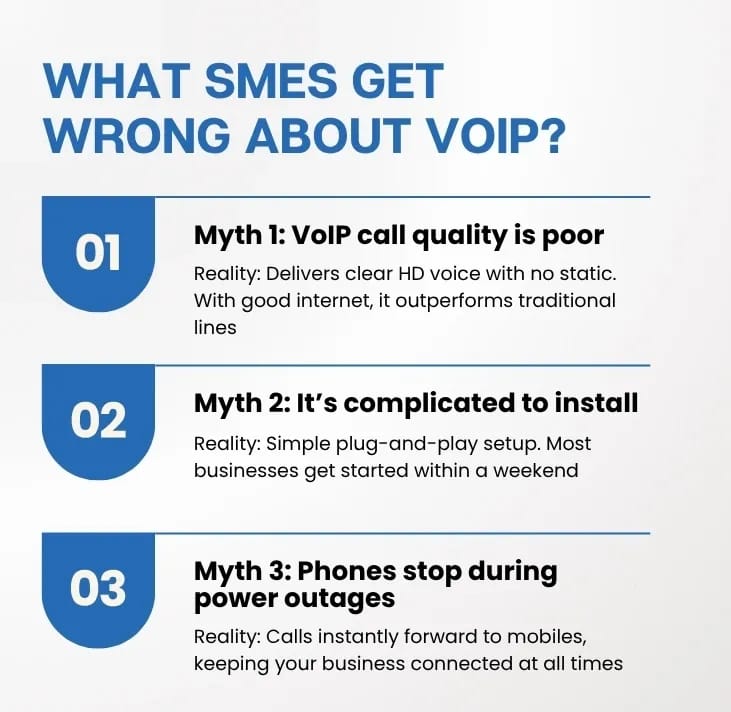
Myth 1: “VoIP call quality is poor.”
Reality: Actually, it’s usually better than your old analog line. Crystal clear. HD voice. Noise cancellation. Zero static.As long as your internet connection is decent and you turn on Quality of Service (QoS) on your router, you’re golden. Plus, most providers automatically switch calls to your mobile network if your internet ever blinks. You won’t even notice.Myth 2: “It’s complicated to install.”
Reality: Hosted VoIP is basically plug and play. Unbox a pre-configured desk phone, plug it into your Ethernet jack, and it sets itself up. Seriously. It downloads its own extension settings automatically.Most businesses finish the whole switch over a single weekend. And your provider’s support team is on the line if you need them. No tech wizard required.Myth 3: “We lose phones during a power outage.”
Reality: This one used to be true for old on-premise systems. But cloud VoIP? Different story. If your office loses power or internet, calls get forwarded instantly to mobile numbers. Your team keeps taking calls from their cell phones. You are never unreachable. Ever.Traditional vs VoIP Systems Comparison
| Feature | Traditional Phones | VoIP Phones for Business |
|---|---|---|
| Cost | High and variable | Fixed and lower |
| Flexibility | Limited | High |
| Remote Access | Not supported | Fully supported |
| Setup Time | Days or weeks | Minutes |
| Features | Basic | Advanced |
| Scalability | Difficult | Instant |
Real-World SME Success Stories
Let me show you how this actually plays out for real businesses.
Case A: The Dental Practice
A dental clinic with four locations had a problem. Patients would call after hours, hear endless ringing, and just give up. Not great when someone has a toothache at 9 p.m.
After switching to VoIP, they set up a simple time-based rule. After 6 p.m., calls automatically route to the on-call dentist’s mobile phone. No more missed emergencies. Patients actually get help. And the clinic’s reputation? Way better.
Case B: The E-commerce Fashion Brand
This online clothing brand got slammed during the holidays. Calls poured in. But they couldn’t afford a full-blown call center with dozens of staff.
VoIP gave them a virtual queue system. Calls got spread evenly across just three support people. No one got overloaded. Plus, they connected their VoIP system to their Shopify orders page with click-to-dial. No more manually typing phone numbers wrong. Customer issues got solved way faster. Happy customers. Less stress.
Case C: The Law Firm
For a law firm, confidentiality is everything. They switched to an encrypted VoIP system with call recording and secure voicemail that goes straight to email.
No more per-minute charges for client calls. No more worrying about sensitive conversations leaking. Plus, they finally had a proper audit trail for compliance. Their billing got cleaner, their clients felt safer, and their phone bill stopped being a headache.
Implementation Roadmap: Upgrading Without Disruption
Switching to VoIP doesn’t have to be a nightmare. Follow this simple plan and you’ll be up and running without any drama.
Step 1: Audit what you actually use
Take a quick inventory. How many phone extensions do you really need? What features are you relying on? Think about things like fax machines, door entry systems, or alarm lines that might be tied to your current phone service. Also, list all your business phone numbers that you want to keep.
Step 2: Check your internet connection
Run a simple speed test. Most business internet these days is totally fine for VoIP. Just make sure your connection is stable. If you want to be extra safe, consider getting a cheap backup internet connection (like a mobile hotspot) for peace of mind.
Step 3: Pick your deployment model
For most small businesses, cloud-hosted VoIP is the way to go. No hardware to buy, no servers to manage. The only time you’d want on-premise VoIP is if you already have a dedicated IT person or team. Keep it simple.
Step 4: Start the number porting process early
Don’t wait until the last minute. Kick off the process of moving your existing phone numbers over to your new VoIP provider well before your go-live date. Your new provider handles all the paperwork. Just give them a head start.
Step 5: Train your team and launch
Set aside a couple of hours for team training. Show everyone the basics: call forwarding, checking voicemail, and using the admin portal if needed. Launch on a Thursday. That way you have Friday to iron out any small issues before the weekend. Then you’re ready for Monday morning.
The Future: VoIP as the Foundation of Unified Communications
Here’s the thing. VoIP isn’t the end of the road. It’s actually the starting point for something much bigger.
Think of it as the foundation. Once you have VoIP phones for business, you can build all sorts of smart communication tools on top. We’re talking about things like AI that transcribes your voicemails automatically. Or software that reads customer emotions during a call and alerts you if someone is getting frustrated. Even automated summaries of every call that get saved straight into your CRM. No more scribbling notes.
SMEs that switch to VoIP today aren’t just saving money on phone bills. They’re stepping into a whole new world where every phone call becomes useful data. And that data turns into real, actionable insights about your customers and your business. In a world where speed and professionalism make or break you, ask yourself this. Do you really want to keep your business tied to a hundred year old copper wire?
Your Partner in VoIP Transformation: Almens Consult
Almens Consult makes the whole process easy. We don’t just sell you a system and walk away. We first look at how you currently communicate and find what’s wasting your time and money. Then we design a voip phones for business setup that fits your SME perfectly. We handle the installation with minimal disruption to your day, and we make sure your system can grow as you grow. Better communication. Lower bills. Less headache. That’s what we deliver.
One Upgrade, Infinite Returns
Businesses that continue using outdated phone systems will struggle with rising costs, slow communication, and poor customer experience. In contrast, companies that adopt voip phones for business gain speed, flexibility, and control over every interaction. The difference becomes visible in daily operations, customer satisfaction, and long term growth. The upgrade is simple, but the impact is significant. The question is no longer whether to switch, but how long a business can afford to wait.